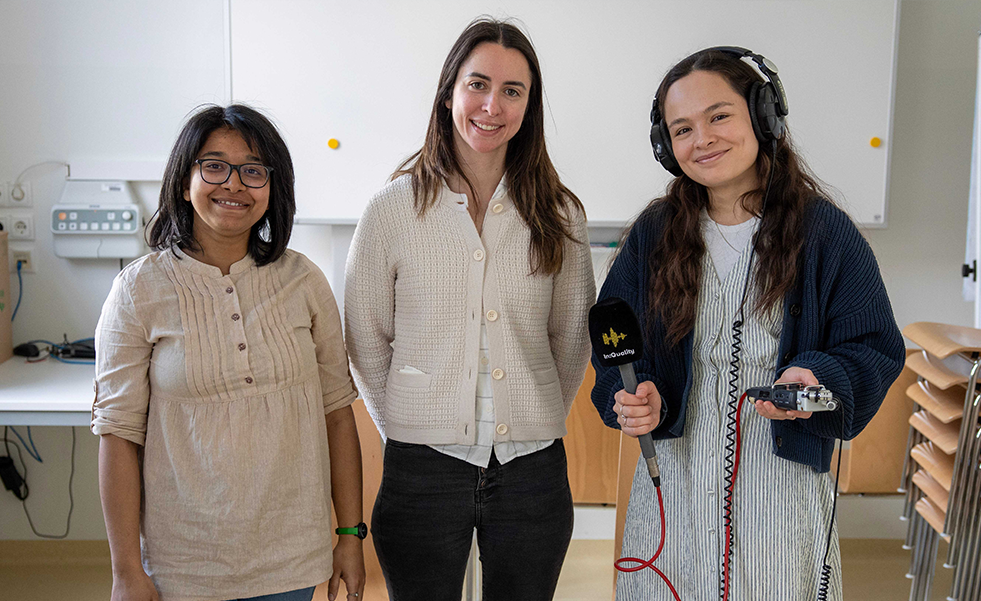
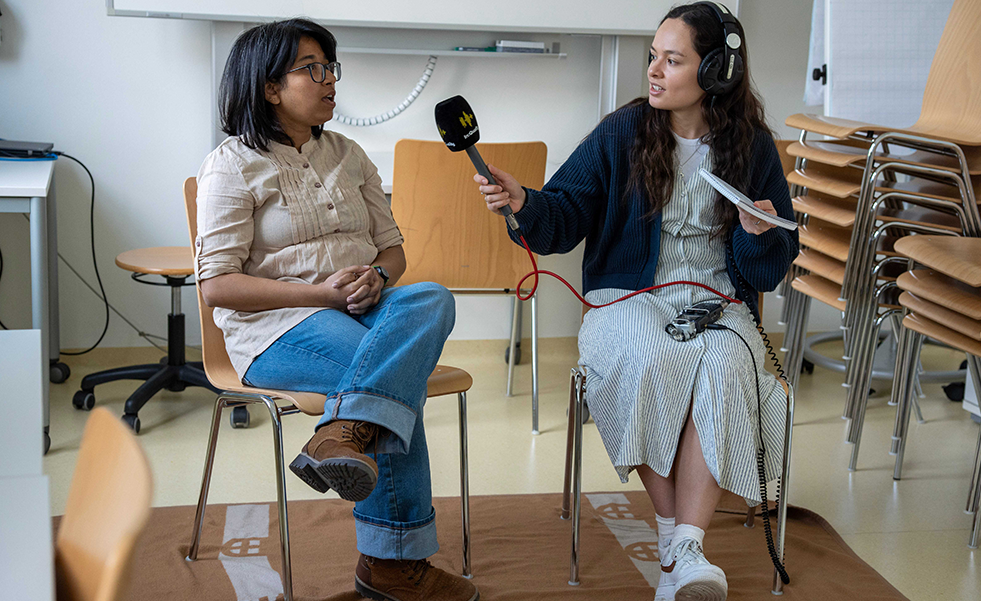
Aiindrila Dhara (MUNI) about her research in podcast series
- Post by: fantom
- 18 June 2026
- Comments off
VIENNA, April 23 Fantom Doctoral Candidates took an important step in developing their communication skills by recording their first podcast series. The session was held with the support of science communication professionals Rhys James and Rachael Ralph from The Naked Scientists.
The initiative provided participants with practical experience in presenting their research to a wider audience. Listen to Aiindrila discussing her research project in a conversation with Rachael.
ABOUT:
Aiindrila Dhara (MUNI)
Investigating the effects on the tumoral heterogeneity of ALCL in treatment resistance development
My PhD research focuses on understanding how cancer cells evolve during treatment, particularly how they become resistant to targeted therapies over time. I study a type of childhood cancer called ALK-positive Anaplastic Large Cell Lymphoma, and I’m interested in why treatment responses vary so much from patient to patient.
This disease is a T-cell lymphoma, diagnosed by the presence of hallmark cells that express the CD30 marker. It is broadly classified into ALK-positive and ALK-negative types, depending on the expression of a protein called Anaplastic Lymphoma Kinase (ALK). In ALK-positive cases, the ALK gene fuses with another gene called Nucleophosmin (NPM). Since NPM is normally expressed in T cells but ALK is not, this fusion leads to constitutive expression of ALK.
This is critical because ALK acts as a driver oncogene. The NPM–ALK fusion protein sits at the top of several key signalling pathways, such as JAK–STAT and continuously activates them. This sustained signalling transforms normal T cells into malignant ones by increasing proliferation and disrupting their normal functions.
Because of this, targeting ALK has become a highly effective treatment strategy, with more than 90% of patients achieving a cure. However, around 10% of patients either do not respond, relapse, or eventually become resistant despite initially responding well.
The central question I am trying to address is: why do we see such heterogeneous treatment responses?
To approach this, I think of cancer as an evolving ecosystem. Within a tumour, different cells can have distinct traits—such as genetic mutations, transcriptional states, or epigenetic modifications—similar to diversity within a natural population. When exposed to treatment, this system is subjected to selective pressure.