
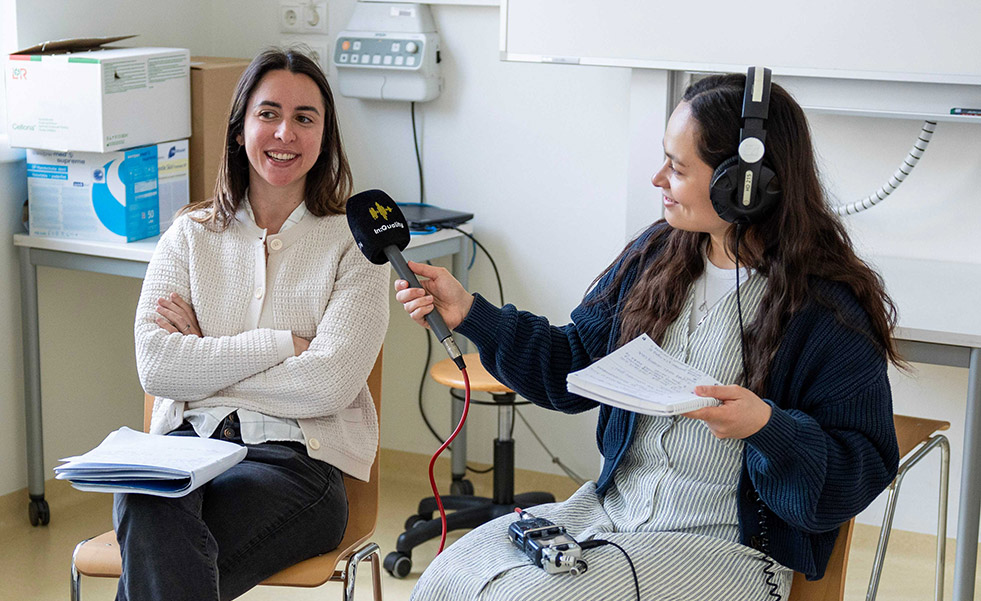
Julia Montague – PODcast session
- Post by: fantom
- 18 May 2026
- No Comment
Julia Montague (UNIMIB) about her research in podcast series
VIENNA, April 23 – Fantom Doctoral Candidates took an important step in developing their communication skills by recording their first podcast series. The session was held with the support of science communication professionals Rhys James and Rachael Ralph from The Naked Scientists.
The initiative provided participants with practical experience in presenting their research to a wider audience. Listen to Julia discussing her research project in a conversation with Rachael.
ABOUT:
Julia Montague (UNIMIB)
Integration of clonal evolution and single-cell mutational and expression profiles in ALK+ ALCL
Some cancers, like anaplastic large-cell lymphoma (ALCL), are driven by a gene called ALK that gets rearranged, causing cancer cells to receive signals to grow more than they should. There are drugs designed to block these signals, and they can work really well at first, however the cancer doesn’t always fully disappear. We think that this is partially due to a small group of cells that go into a sort of survival mode called drug-tolerant persister cells (DTPs), which you can think of as sleeping cancer cells. They slow down and stop dividing, but avoid being killed by the treatment, only to wake up later and make the cancer return—sometimes more aggressively than before.
My research focuses on understanding what keeps these sleeping cells alive even when being targeted by anti-cancer drugs, like ALK inhibitors. Using cancer cells grown in the lab, we discovered that when exposed to treatment, some cells switch into this “sleep mode” through two mechanisms. First, we found that the sleeping cells had changes to their DNA methylation. DNA methylation is an important way in which cells can regulate what parts of their DNA are turned “on” or “off” without modifying the actual DNA code, a process known as epigenetics. Second, the sleeping cells increased the production of a particular transcription factor—a protein which acts like a molecular switch. Similar to DNA methylation, these switches bind to the DNA and decide which genes will be used. When we blocked the switches with drug combinations targeting both ALK and the transcription factor, the sleeping cells “woke up” and became sensitive to the drug treatment again. Now we are trying to figure out which genes the transcription factor controls in ALK+ ALCL to gain a better insight into its importance and function in cancer